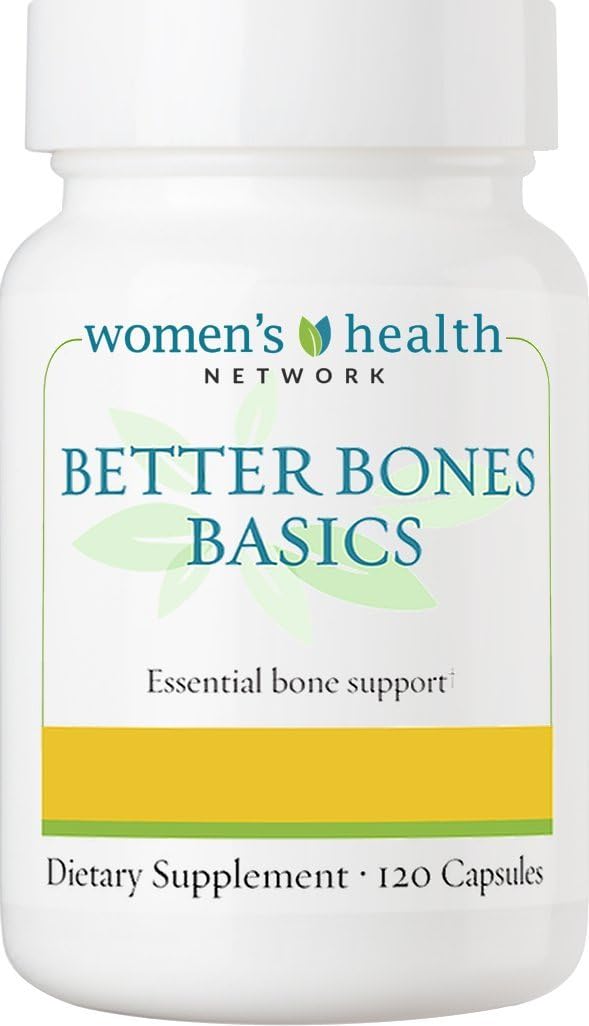
Another bone support product that has all or most of the same ingredients is in review today.
As with most, this product would have you supplementing calcium which is clearly not wise as it leads to heart attacks, kidney stones, constipation, as well as increased risk of more bone loss and higher fracture rates. It also decreases stomach acid due to the alkalinity of calcium which will throw off proper digestion and possibly lead to other digestive issues like Leaky Gut, as well as IBS/IBD, colon cancer and more.
Below is the ingredients label from this product.

- Vitamin (hormone) D3 is the first ingredient. There are many reasons to avoid supplementing D3 but one important reason for those with osteoporosis is that it causes further loss of bone density 1 as well as setting the stage for hypercalcemia which is more common when taken in combination with calcium, which is also in the formula.
- Vitamin K (K1) is not an issue but it also has K2 MK7 and since it does not specify the source, it can likely be assumed to be legume based. This presents several issues. Legumes have high levels of antinutrients. Most MK7 is made from *soy, natto, *nattokinase (worse than *natto), chickpeas, or alfalfa. These are also sprayed heavily with Glyphosate (known to cause cancer) and all soy, which includes natto and nattokinase, is an endocrine disruptor that will throw off hormone balance, needed for bone building. Since the bottom of the label (other ingredients) says “soy” we know it is one of the three types of soy. Vitamin K or K1 (same) must be processed by the liver and is then converted to MK4. K2 MK7 is needed to offset the effects of hormone D3 which works to get calcium absorbed into the bloodstream. That calcium will stay there and calcify in blood vessels and/or arteries if there is not sufficient K2 MK7 to move it to the bones and teeth. This requires 100 mcg per every 1000 units of D3 is taken at the same time. This formula has 2000 I.U. of D3 but only 100 mcg of K2 MK7. This means it has half what it needs to do its job. This can lead to trouble.
- Calcium in the form of both Carbonate (hard to absorb) and Citrate. While Citrate is known to help with absorption, it has many nasty side effects, one being that it pulls minerals from the bones (calcium and potassium). But it is also known to cause kidney stones (See “The Calcium Lie 2” by Dr. Robert Thompson) and kidney damage from long-term use. This may be from the GMOs as Citrate is made primarily from GMO sugar beets or cassava; or just the Citrate itself. There are other side effects of Citrate such as Aspergillus toxicity as well as increased aluminum absorption.
- Magnesium Carbonate/Citrate is also an ingredient and the one thing I do see right here is that the magnesium matches the calcium at the proper 1:1 ratio. But unfortunately, it presents more issues from Citrate.
- Zinc is fine but is in the form of oxide which is harder to absorb.
- Boron is included but once again we have even more Citrate. The dose is also insufficient since 20 mg of boron is suggested, though it may be fine if one has gotten boron from the diet.
- Horsetail – good for OP and no issues.
- “Other ingredients” is usually where we see problems with supplements. This is better than some but still poses some problems. Gelatin may or may not be fine but likely is not organic or from pasture-raised sources. Rice flour is an issue as rice contains arsenic. This could be used as part of the capsule or a anti-caking agent but introduces at least some arsenic. Vegetable Stearate may or may not be an issue but is of less or lesser concern. It also contains Milk though I’m not sure which ingredients it’s associated with but it is almost certain not to be organic or pasture-raised which means GMOs, Glyphosate, growth hormones, antibiotics, and more.
This review is an opinion
Written by Douglas K. Johnson – Life, Health and Wellness Coach, Herbalist, Nutritionist, and Author
Medical Disclaimer
This blog provides general information and discussion about medicine, health, and related subjects. The words and other content provided in this blog, and in any linked materials, are not intended and should not be construed as medical advice.
If the reader or any other person has a medical concern, he or she should consult with an appropriately-licensed physician or other health care worker.
Never disregard professional medical advice or delay in seeking it because of something you have read on this blog or in any linked materials. If you think you may have a medical emergency, call your doctor or 911 immediately.
The views expressed on this blog and website have no relation to those of any academic, hospital, practice or other institution with which the authors are affiliated.
 Naturally Better Bones