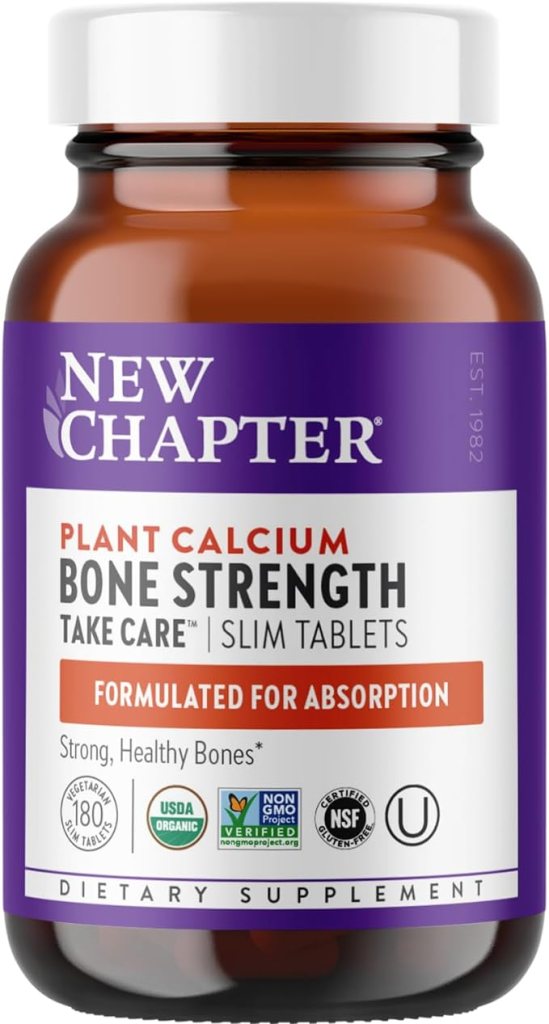
Though better than some similar bone support products, it has antinutrients and disproportionate dosages like all such products. Let’s look at the ingredients.
Supplement Facts
Serving size 3 Tablets
Servings per container 40
| Amount per serving | % DV | |
|---|---|---|
| Vitamin D3 (as cholecalciferol from ferment media) | 1,000 IU | 250% |
| Vitamin K1 (as phylloquinone from ferment media) | 35 mcg | 44% |
| Vitamin K2 (as menaquinone-7 from natto) | 45 mcg | 56% |
| Calcium (from algae Lithothamnion[Lithothamnion calcareum and Lithothamnion corallioides]) | 770 mg | 77% |
| Magnesium (from algae Lithothamnion[Lithothamnion calcareum and Lithothamnion corallioides]) | 58 mg | 14% |
| Strontium (from algae Lithothamnion[Lithothamnion calcareum and Lithothamnion corallioides]) | 5 mg | • |
| Silica (from algae Lithothamnion[Lithothamnion calcareum and Lithothamnion corallioides]) | 2 mg | • |
| Vanadium (from algae Lithothamnion[Lithothamnion calcareum and Lithothamnion corallioides]) | 13 mcg | • |
Other ingredients: Organic barley grass powder, organic gum acacia, ferment media (organic soy flour, organic Saccharomyces cerevisiae, organic alfalfa powder, papain [deactivated], bromelain [deactivated], lactic acid bacteria [Lactobacillus acidophilus, Bifidobacterium bifidum and Lactobacillus rhamnosus]), silica and hypromellose.
Contains: Fermented soy.
The following is an updated or different label that shows the above as well as some other ingredients not shown in the above.
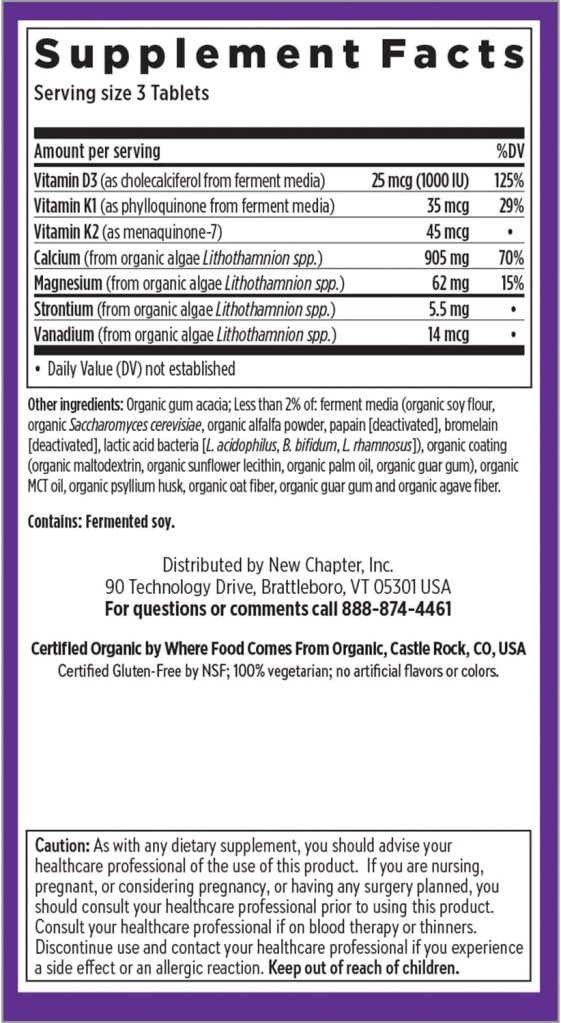
This would have one taking D3, which is not supported by experts. Supplementing D3 can cause bone loss when taken above the RDI limits, according to some studies. Further, supplementing over the RDI is not suggested as it shows no benefit for OP. This is over that limit and despite being plant-based, may still cause issues with loss. Supplementing vitamin D3 has been shown in studies to cause the loss of bone mineral density (BMD) with exponentially increasing loss with increased doses. Although this is considered as being “food-based” it is from a ferment media (Saccharomyces cerevisiae) that some say causes yeast infections and other issues. 1 So is the vitamin K1. Another issue is the RDI for D3 is only 600 I.U./ 800 I.U. over age 70. Studies have shown more than the RDI to be of no more advantage than the RDI.
The K2 is natto made from soy. Despite being organic, soy still presents many issues being high in many antinutrients, including lectins and saponins, which damage the gut, phytates, and oxalates, which hinder mineral absorption. It is also an endocrine disruptor that should be avoided, regardless of form. It will throw off the hormone balance needed for optimal bone building. The lectins and saponins, both are known to destroy the gut lining and can lead to Leaky Gut, a known cause of OP and agent of exacerbation, and a major loss of nutrient absorption and immune support as the gut makes up 70% of the immune system. Most natto in supplements is actually nattokinase, which is even worse. Another problem with this is the ratio is off (common for such products) as D3 must be matched with the proper amount of K2 MK7 @ 100 mcg per every 1000 units of D3. With D3 @ 1000 I.U., this should have 100 mcg of K2 MK7. It is shy by 55 mcg. It also lacks K2 MK4, which is beneficial for moving calcium from soft tissue to the bloodstream so MK7 can move it to the bones.
This would also have you supplementing calcium. This is a problem in that it has been shown to cause heart attacks, strokes, and hypercalcemia. It also increases the risk of fractures, increased bone loss, kidney stones and damage, and constipation. It was also shown in studies to give only a 1% increase in BMD for only a year and then stop completely. It also neutralizes stomach acid needed for proper digestion and nutrient absorption, which can lead to acid reflux, which in turn can lead to Leaky Gut, a condition known to cause and exacerbate OP and more. Also, the dose would need to be split up as more than 500 mg of calcium cannot be absorbed at one time, which can lead to Hypercalcemia/Hypercalciuria. This also presents yet another issue in that anytime calcium is ingested, magnesium needs to be matched at 1:1 or higher. This falls severely short of that by over 700 mg. This is both dangerous and unhealthy. The alternate label shows calcium even higher at 905 mg.
Strontium is not wise to supplement either. As covered in “Opening the Doors to Reversing and Healing Osteoporosis,” Strontium has been shown to cause blood clots and memory loss, among other things. It also boosts aluminum absorption from supplements, foods, etc. 2 The alternate label also shows strontium to be higher at 5.5 mg
As with all other bone support products, this doesn’t waiver much in its effects. Though most of the ingredients are organic and/or from fermented media, the media itself is tainted as it’s made with soy and is said to be a cause of yeast infections.
But as with so many products, there are some issues with the “other ingredients” which is where I tell most people to look, as this is where most products show the antinutrients they contain. While I notice a few that can be troublesome, there is one that stands out: Maltodextrin. And while it is organic, it is a sugar and quickly converts to glucose in the body. The problem here is that glucose in the blood hinders vitamin C by 75% for up to six hours and many minerals for as long. This would compromise much of the minerals listed in the formula and negate much of the benefits.
While slightly better than some, this would still present such issues, making it unworthy. Further, as always, it is best to obtain each nutrient separately to have full control, as one has none over any one nutrient, as they are all blended together. If one needs adjusting, the ability to correct is not there.
It is also likely you would still need to supplement some of these. It is best to always get only the nutrients you need on their own separately, and from our most natural sources first: Vitamin D from sunshine first, then food, and all others from food first, except calcium which needs to come from food unless deficient. And then, only one form is appropriate. This does not have that form.
Written by Douglas K. Johnson – Life, Health and Wellness Coach, Herbalist, Nutritionist, Investigative Journalist, and Author
References, Sources, and Citations:
 Naturally Better Bones